STATEMENT 2025
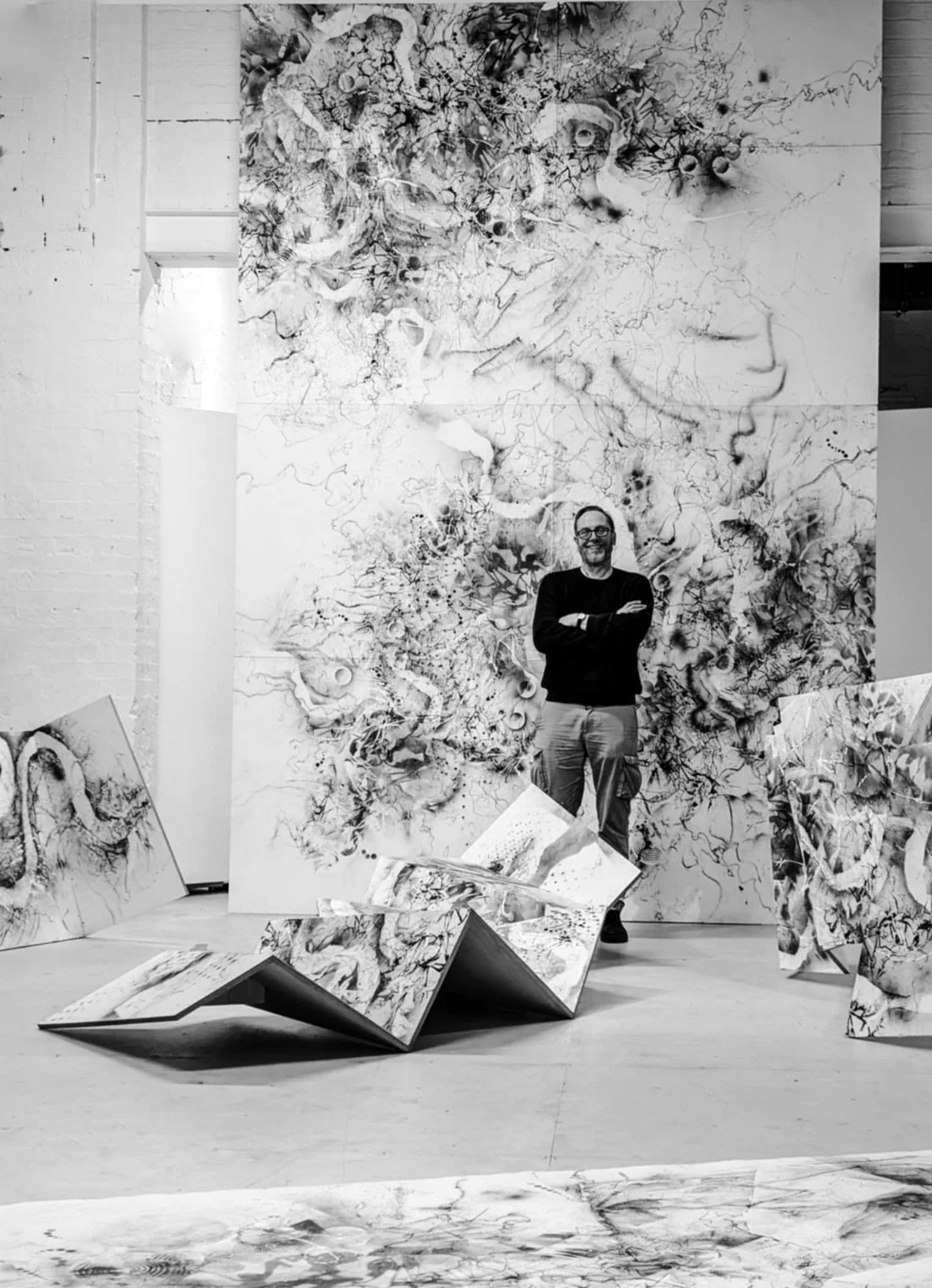
Photograph by Marcin Sz
I am a visual artist collaborating with an award-winning particle physicist, Professor Kostas Nikolopoulos on a project called “The Sketchbook and the Collider.”
Research reveals reality across various scales is a series of “events” not “objects.” From the interaction of fundamental subatomic particles creating all visible matter to the forming of neuronal networks in the brain creating consciousness. Prompting the idea of a common rhythmical “choreography” unfolding across the universe at vastly different scales.
I explore relationships between the basic elements of drawing and these fundamental rhythmical units.
I reach out via engagement workshops with participants investigating a personal experience of “the rhythmic” incorporating their responses in collaborative artwork.
‘Expanded’ drawing approaches combine moving image elements with drawings on sculptural forms that must be negotiated in immersive installations: Embedding interaction, collaboration and participation in response to this universal rhythmical pattern underlying the interconnected nature of all things.
If everyone were aware of the ramifications of particle physics research: that we are being created by the interaction of a few fundamental particle types, all matter, living and inanimate interconnected via these fundamental building blocks then this awareness would transform attitudes to ourselves, each other and the world around us.
Understanding this radical connectivity intellectually is not enough it needs to connect more forcefully with our everyday experience. It must be “felt.” I explore it through the direct material engagement inherent in the drawing process and embed it in the “making” activities for workshop participants.
This project links ways of probing the universe often thought of as opposites, art and science. It links places of scientific research with cultural centres opening dialogues between them. The workshops developed and facilitated by artists and physicists working together creating content and collaborative delivery models tests new ways of thinking and working.
This research is timely given our current fractured societal situation and global climate crisis. Artists, scientists and members of the public working together through exhibitions and art engagement workshops develops an understanding that through these fundamental connections we can think differently, change attitudes and secure the future.

STATEMENT 2020
In discussion with Prof. Nikolopoulos it became clear that despite obvious differences our specialisms of fine art and particle physics are both concerned with making the invisible visible.Scientific developments have seen the “everyday” dissolve into sub-atomic interactions only accessible by examining traces left in an enabling medium in a detector. A process mirrored by the artist expressing ideas and emotions through marks made and materials manipulated. Taking the same journey from something hidden to something revealed.
Indeed the physicist’s relationship to their detectors has striking parallels with the relationship of the artist to their media and methods. In 1989 physicist Carlo Rubbia stated that detectors are how physicists express themselves just as painters use painting and sculptors sculpture.
Initially we compared the material cultures surrounding our two disciplines and focused on a piece of essential equipment in each case, the sketchbook and the most advanced form of detector; the particle collider. We felt that bothare connected as arenas where different elements are brought together, sometimes violently involving “active processes” that create and examine the visible traces of hidden interactions to determine if something significant has happened to change the way we understand the world around us. In artistic terms an idea worth developing.
I decided to expose the mechanics of making a drawing in the same way that Prof. Nikolopoulos was revealing elemental particles and I sought to establish equivalents between the particle characteristics of spin, mass and charge and the graphic elements of point, line and shape.
This creates an intimate visual and conceptual connection between my visual language, the fundamental artistic activity and the interaction of elemental particles that create the universe.
Physicist Carlo Ravelli states that the quantum world describes things not as they are, but as they occur and interact, a world not of objects but of events. Drawing is a process that is best suited to capturing the ephemeral and elements in flux and therefore a perfect vehicle for exploring the particles as they decay and interact, sometimes existing for a fleeting moment before changing again or annihilating in a collision.
However despite drawings’ capacity to respond to the “fleeting” the final outcome is a static object to be viewed and this led to the use of “moving image” work where footage of elements drawn with a 3-D pen are manipulated and edited in a way equivalent to the processes that particles undergo in the Collider. Certain sequences were isolated, played at accelerated rates and then overlaid in opposite directions. Played as a loop on projector or screen the artistic equivalents of the constant interactions, transformations and “choreography” of the force and matter particles can be more successfully brought together.
The issue here is of course that although we now have actual movement of the drawn elements they are predetermined once the filming and editing process have been completed. This led to “live” drawing performative pieces involving the interaction of people whether artists, scientists or members of the public themselves “making marks” on a communal drawing surface. Using the visual language “equivalent” drawings like musical scores or graphic notation to suggest types of marks to be made and incorporating the sound of the different media being used. A “drawing orchestra” creating equivalents in sound and vision to the hidden choreography of particle interactions.